- Iraq,Erbil / Istanbul,Türkiye
- info@socigate.com
Office Address
Iraq,Erbil
Istanbul,Türkiye
Phone Number
+9647738898880 +9647500998880 +905373192859
Email Address
info@socigate.com
Iraq,Erbil
Istanbul,Türkiye
+9647738898880 +9647500998880 +905373192859
info@socigate.com
 by Socigate
 Artificial intelligence in marketing is no longer just a temporary technology trend. It has become an essential part of how campaigns are planned, audience behavior is analyzed, content is created, and results are optimized.
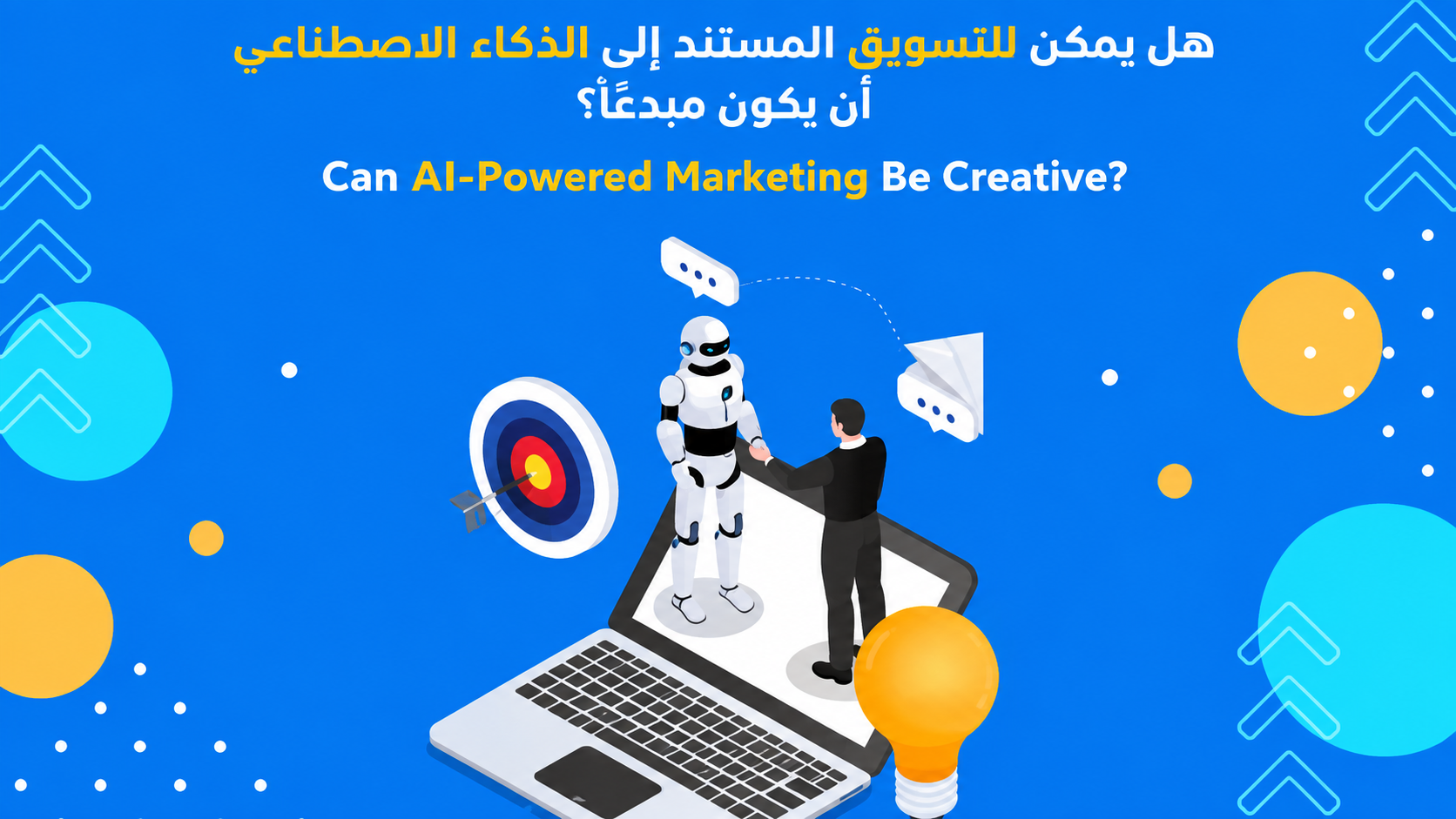
With the growing adoption of Applications of artificial intelligence, an important question has emerged among marketers and brand owners: Can AI-powered marketing truly be creative, or does creativity remain a uniquely human capability that machines cannot replicate?
The answer is not simply yes or no.
AI can accelerate the creative process, suggest unexpected ideas, analyze large volumes of data, and generate dozens of alternatives in a short period of time. However, it still needs human intelligence to set the direction, understand emotions, select the right idea, and give content an authentic personality that reflects the brand’s identity.
That is why the strongest marketing campaigns do not rely solely on humans or solely on artificial intelligence. Instead, they combine the efficiency of technology with human imagination.
AI-powered marketing refers to the use of intelligent systems to collect and analyze data, understand customer behavior, personalize marketing messages, create content, and optimize campaign performance.
Artificial intelligence can be used in many marketing activities, including:
However, simply using an AI tool does not automatically make a campaign creative. True creativity emerges when the capabilities of these tools are transformed into an experience that is useful, relevant, and impactful for the audience.
Artificial intelligence can generate text, images, and ideas that appear creative because it analyzes large amounts of information and patterns before recombining them into new outputs.
However, there is a significant difference between generating content and developing a powerful marketing idea.
AI may generate twenty headlines for a single advertisement, but choosing the headline that accurately represents the brand, fits the audience’s culture, and creates the intended emotional response still requires human judgment.
It may also suggest an attractive visual design, but it cannot always determine whether that design truly reflects the values the brand wants to represent.
Therefore, AI should not be viewed as a replacement for creative professionals. Instead, it should be treated as a partner that helps them explore possibilities, experiment with different ideas, and achieve better results in less time.
Successful creative campaigns begin with understanding people, not simply choosing a beautiful design or writing a catchy phrase.
Artificial intelligence helps marketing teams analyze the questions customers ask, the topics they are interested in, the problems they face, and the types of content they engage with.
These insights can reveal a marketing angle that may not have been obvious before.
For example, instead of creating a general campaign for a skincare product, audience analysis may reveal that customers are not simply searching for a new product. They may actually be looking for a simple skincare routine that fits their busy lifestyles.
At that point, the insight becomes a creative idea that can form the foundation of an entire campaign.
Finding the right idea can take a considerable amount of time, especially when marketing teams are working under tight deadlines.
AI can be used at the beginning of the creative process to generate different campaign angles, suggest slogans and headlines, propose visual concepts, and develop different versions of the marketing message.
This does not mean accepting the first suggestion generated by the tool.
Instead, AI outputs should be used as a starting point.
The team can review the ideas, combine several suggestions, remove generic elements, and develop a more original direction that is closely connected to the brand.
Not every customer responds to the same marketing message in the same way.
One customer may care most about price, another may prioritize quality, while a third may focus on ease of use.
Artificial intelligence helps brands create different versions of a message based on the needs and priorities of each audience segment.
For example, one campaign could include:
In this case, creativity is not limited to the visual appearance of the advertisement. It also involves delivering the right idea to the right person in the right context.
Producing a large number of advertising variations once required significant time and budget.
Today, AI can help marketing teams create multiple versions of headlines, advertising copy, visuals, and calls to action.
These alternatives can then be tested to determine which elements generate the strongest response.
However, testing does not mean allowing numbers to make every decision.
An advertisement may achieve a high click-through rate while making an exaggerated promise or attracting the wrong audience.
For this reason, performance data should always be evaluated alongside brand objectives and the quality of the overall customer experience.
AI tools make it possible to create initial campaign concepts, suggest visual directions, generate image prototypes, produce short videos, and modify visual elements quickly.
Marketing teams can use these tools to experiment with several creative directions before beginning final production.
This flexibility may also help smaller businesses test ideas that previously required substantial production resources.
Nevertheless, every visual element should still be reviewed carefully to ensure accuracy, quality, realism, and consistency with the brand identity.
A single core idea can be transformed into multiple types of content.
For example, a comprehensive article can be repurposed into:
Artificial intelligence can speed up this process significantly, while the human team reviews each version to ensure that it is appropriate for the platform and the intended audience.
Despite the capabilities of artificial intelligence, there are still important areas in which human expertise remains essential.
Customers do not purchase products based on specifications alone.
They may buy because they are looking for security, confidence, comfort, belonging, convenience, or a sense of distinction.
An experienced marketer can understand these motivations and transform them into a story, a message, and an overall experience.
AI can help identify patterns, but it does not experience human emotions in the same way people do.
A phrase that works well in one market may be inappropriate in another.
Similarly, a particular color, expression, visual, or reference may carry different meanings depending on the culture.
Marketing campaigns therefore require human review from people who understand the language, culture, and context, especially when communicating with audiences across different regions or generations.
AI tools may generate grammatically correct content that still feels generic and could easily belong to any company.
The human role is to give the brand a distinctive and recognizable voice.
The goal is to create content with such a clear personality that the audience can recognize the brand even before seeing its name.
Technology makes highly personalized marketing possible, but not everything that can be done should necessarily be done.
Brands need clear boundaries around the use of customer data, should avoid manipulative messaging, and must carefully review AI-generated information before publishing it.
Artificial intelligence can suggest multiple directions, but it cannot independently determine which direction best serves the long-term future of a company.
The human team remains responsible for defining campaign objectives, target audiences, key messages, budget, success metrics, and acceptable levels of risk.
Suppose a company offers a task management application and wants to launch a campaign targeting small business owners.
Instead of simply asking an AI tool to write a general advertisement, the company can follow a more strategic process.
The problem is not that the audience does not have access to task management applications.
The real problem is that small business owners often feel overwhelmed by tasks, deadlines, customers, and competing responsibilities.
The goal is to increase free-trial sign-ups among small business owners.
The brief should answer questions such as:
The team can ask the AI tool to generate ten different campaign angles, such as:
The team may choose the concept:
“Your business needs your focus, not more chaos.”
The idea can then be refined to match the brand’s personality before being developed across visual assets, advertising copy, and the landing page.
The team can create one version focused on time management, another focused on organization, and another focused on team coordination.
These versions can then be tested with different audience segments.
Performance analysis should not focus only on click-through rates.
It should also consider registrations, actual product usage, and whether customers continue using the application after the free trial ends.
This approach makes AI part of a complete creative process rather than simply a tool for producing content quickly.
AI-generated outputs may contain inaccurate information, repetitive phrases, or claims that cannot be supported.
For that reason, both text and visuals should always be reviewed before publication.
The more general the prompt, the more generic the result is likely to be.
Instead of writing:
“Create an advertisement for our product.”
Provide the tool with information about the audience, campaign objective, customer problem, brand tone of voice, platform, and desired call to action.
Using AI without a clear brand voice guide can result in inconsistent content across different platforms.
Brands should define preferred terminology, phrases to avoid, the desired level of formality, and how the audience should be addressed.
Personalization can improve the customer experience, but it can also become uncomfortable if users feel that a brand knows too much about them.
Customer data should therefore be used responsibly, with clear value provided in exchange for the information customers choose to share.
A large number of views or clicks does not necessarily indicate campaign success.
Performance should be linked to the actual business objective, whether that means sales, inquiries, subscriptions, customer retention, or another measurable outcome.
Having access to many tools does not guarantee better results.
What matters more is having a clear process that determines when each tool should be used, who reviews its outputs, and how success will be measured.
To create distinctive content, begin with the information that generic AI tools do not already know about your company.
This may include:
When these details are added, the content moves beyond generic information and begins to reflect real expertise and experience.
It is also advisable to include the name of the writer or reviewer, update the article when information changes, and clearly demonstrate the expertise of the organization providing the content.
The need for marketers will not disappear, but their role will continue to evolve.
The value of repetitive tasks that can be automated is likely to decrease, while skills that require understanding, context, judgment, and creativity will become increasingly important.
These include:
Marketers who know how to use artificial intelligence effectively will be able to accomplish more, test more ideas, and make better-informed decisions.
However, relying entirely on AI tools without marketing expertise may result in content that is abundant but repetitive, fast but ineffective, and structured but lacking personality.
At Socigate, we do not treat artificial intelligence as a replacement for strategic thinking.
Instead, we use it as a tool that supports the development of faster, more accurate, and more effective marketing campaigns.
We begin by understanding your business, your audience, your objectives, and your position in the market.
We then determine the most appropriate tools, channels, and marketing messages.
By combining analytics, content creation, design, platform management, and search engine optimization, we work to build a digital presence that reflects your brand and delivers measurable results.
Yes, AI-powered marketing can be creative, but creativity does not come from the technology alone.
The real value of artificial intelligence lies in its ability to analyze information, accelerate exploration, generate alternatives, personalize experiences, and optimize campaigns.
Human professionals, however, contribute vision, emotion, context, identity, judgment, and responsibility.
When these elements work together, artificial intelligence does not become a competitor to creativity. Instead, it becomes a tool that expands creative possibilities and helps brands develop ideas that are more relevant and meaningful to their audiences.
AI can support research, brainstorming, draft writing, content production, and performance analysis.
However, a complete marketing campaign still requires human oversight to define the strategy, review messaging, and ensure consistency with the brand.
It can be suitable when it provides genuine value to readers, is carefully reviewed, and includes original expertise and useful information.
Publishing large volumes of generic content without adding meaningful value is unlikely to create a strong user experience.
The best use depends on the needs of the business.
Some of the most valuable applications include audience analysis, idea generation, message personalization, content repurposing, and testing multiple versions of advertisements.
AI may take over some repetitive tasks and first-draft production, but it does not eliminate the need for writers who can understand audiences, build stories, verify information, and create a distinctive brand voice.
Start with a clear and specific task, such as generating content ideas or preparing initial versions of an advertisement.
Establish a review process, compare the results with your business objectives, and gradually expand your use of AI based on what delivers genuine value.
